Best Vegan Travel Tools for Airports, Road Trips, and Last-Minute Meals
A good vegan meal can be worth a detour. A disappointing one is more annoying when it has also cost half an hour, an expensive delivery fee or a long walk through the wrong terminal. The best vegan travel tools help distinguish those outcomes before the trip has narrowed the choices too far.
We’d use vegan travel tools with different strengths rather than ask one restaurant app to handle everything. HappyCow is a good starting point for choosing where to eat in an unfamiliar place. VeggL becomes more useful when the choice is already a particular chain or airport. A route, an airline meal request and a hotel-room grocery order each need different information.
The aim is a vegan meal that suits the journey: something worth eating, reachable at the right time, with preparation clear enough to order confidently. Here is how we’d make those decisions on a vegan road trip, at an airport and after a late arrival.
Key Takeaways
- Choose HappyCow when you can compare vegan options across restaurants; choose VeggL when a chain or venue has already narrowed the menu.
- Compare the whole road-trip stop with the quality of the meal, not just the restaurant’s distance from the highway.
- Airline special meals and airport restaurants are separate options, with different eligibility and access limits.
- After a late arrival, a straightforward delivery order or room-ready groceries can be better than a dish needing several changes.
- Offline maps and translation have specific feature limits; a downloaded area does not give every app the same abilities.
Choose Vegan Travel Tools by the Meal Decision
The most useful comparison between vegan travel tools is the question each can answer. A restaurant finder can reveal a place worth visiting without telling you whether it is a sensible motorway stop. A chain-order guide can explain an ingredient substitution without making that chain the most enjoyable choice for dinner.
| Tool or source | Decision we’d use it for | What still needs settling |
|---|---|---|
| HappyCow | Which restaurants or shops offer appealing vegan food in an unfamiliar place? | Whether the available meal fits this visit, rather than a past review |
| VeggL | Which vegan options make a plausible order at this chain or fixed venue? | Local menu differences and the preparation of the order |
| A route map | Is the meal worth the journey there and onward? | Whether the restaurant itself is a good choice |
| The airline’s meal rules | Is a vegan special meal available on this flight? | Eligibility, the request deadline and any reservation changes |
| The airport’s directory | Which food locations belong to this terminal or concourse? | Access from the gate and the particular location’s menu |
| Restaurant or grocery delivery | What dinner can arrive where we’re staying? | A clear dish or product choice, substitutions and useful room equipment |
HappyCow for an open choice, VeggL for a constrained one
HappyCow’s mobile app combines restaurant and shop discovery with place filters, community reviews and saved places, including offline access to saved places. Its official mobile guide describes those functions. That makes it our preferred starting point when the question is where to find vegan food in a new neighborhood. There is room to compare an all-vegan restaurant, a mixed restaurant with a substantial vegan menu and a shop that might make tomorrow’s breakfast easier.
We’d judge vegan options on the shortlist by the meals they offer. A restaurant with a clearly described main course is a stronger dinner prospect than a place whose attraction is one dessert. An all-vegan menu is particularly useful for a group that wants to share dishes without working through a different set of modifications for every plate. A mixed restaurant may be the better choice when its vegan main is appealing and the rest of the group wants a different style of food.
VeggL takes a more constrained problem. Its guides cover United States chains, airports, sports venues and theme parks, and it warns that offerings can vary locally or change. VeggL explains its scope and those menu limits. We’d turn to it when the available restaurant is already known: a chain at the next useful exit, a venue concession or a terminal food court. Its value is shortening the work of finding a plausible order within that menu.
The distinction matters most when a promising-looking result is only a partial meal. A chain guide may identify a vegan side, bread or topping without turning the combination into the dinner you want. We would rather choose a different stop than pay restaurant prices for an improvised collection of sides, unless the convenience is worth that compromise. Conversely, an exit-side meal you already understand can be the better road-trip choice than a more interesting restaurant that needs a large detour.

Give a short trip a short tool list
For a city break, we’d begin with HappyCow and the route tool already in use. For a journey built around motorway services or fixed venues, we’d give chain guidance more weight. A complex drive may justify a dedicated route-planning app; a single overnight trip may not. The additional tool earns its place only if it changes a stop, makes a meal easier to reach or solves a limitation the existing tools cannot.
There is also a useful distinction between an advance choice and a last-minute one. With an afternoon free, a restaurant can be the destination. With forty minutes before boarding, it has to fit the airport. A meal app should support the trip you actually have, rather than tempt you into treating every meal as a destination outing. Our guide to eating well anywhere takes the same practical view of choosing food around a journey’s real constraints.
Build a Vegan Road Trip Around Worthwhile Stops
A good vegan road trip has room for both useful stops and meals worth a longer break. Google Maps provides estimated travel times, route choices and places along a route. Google describes those route-planning functions. We’d compare the whole interruption to the drive: leaving the road, reaching the restaurant, eating and rejoining the route. The shortest distance to a promising pin is not necessarily the smallest interruption.
Choose the exit and the meal together
iExit is designed around upcoming exits on United States interstates, showing services ahead rather than just businesses near the current location. Its official guide describes that interstate-exit focus. We’d use it to compare the next plausible stops, then use vegan-specific guidance or the restaurant’s own menu to decide whether any of those stops offers a meal we’d want. Among vegan travel tools, it helps choose the exit rather than the dish, and its U.S. interstate scope should not be mistaken for worldwide route coverage.
That is a different job from HappyCow’s. If the town ahead has several independent restaurants with vegan options, HappyCow can help establish whether the town is worth leaving the main route for. If the useful exit has only a familiar chain cluster, VeggL may settle the order faster. We’d choose the tool according to the available decision instead of starting the same broad restaurant search at every stop.
Consider a hypothetical choice between a vegan restaurant twenty minutes off the route and a clear exit-side order. The detour adds about forty minutes of driving before parking, ordering or eating. For an unhurried lunch, an appealing restaurant might justify that time. For a late drive to a hotel, we’d usually favor the simpler meal unless the restaurant is a particular reason for making the trip. Calling both choices vegan options does not make them equivalent: one is a destination meal, and one serves the journey.
The same distinction applies to a destination restaurant at the end of the drive. We’d treat dinner there as a bonus if arrival is uncertain, rather than make the day’s vegan food depend on a kitchen still serving late. A stop earlier on the route can be the better meal decision even when the restaurant near the hotel looks more exciting.

Let the grocery store compete with the restaurant
We wouldn’t automatically rank a grocery stop below a restaurant stop. If the restaurant choice is a plain side salad and fries, bread, hummus, vegetables and fruit may make a more appealing lunch. The useful comparison is the vegan meal you can actually assemble, not the status of buying vegan food across a restaurant counter.
For a driving day, we’d favor food that is comfortable to eat at the stop or easy to divide among the group. A substantial prepared dish can be useful; several packages needing separate heating or utensils can make the meal awkward. The pantry guide is a useful starting point for combinations that work as food rather than emergency snack piles.
A grocery stop is less persuasive when the trip offers nowhere suitable to prepare what you’re buying. A frozen dinner can be a fine hotel-room option with a microwave, but it does little for a car journey with no way to heat it. We would compare the store’s practical meal choices with the nearby restaurant before committing to either. For this decision, a shorter stop with a complete, clearly vegan meal is often worth more than another app full of distant possibilities.
Treat Airport Access and Airline Meals as Separate Problems
An airport search and an airline meal request solve different parts of the day. We’d consider a special meal for an eligible flight and still make a separate decision about vegan food before departure or after landing. Neither option needs to carry the whole journey.
Choose the vegan airline meal, not a vegetarian approximation
American Airlines offers special meals on eligible flights with meal service, with requests allowed from thirty days before departure until twenty hours beforehand. Its Vegetarian/Vegan meal excludes meat, fish, fowl, eggs, dairy and their derivatives; its other vegetarian meal categories may include dairy or eggs. American’s special-meal page gives the meal definitions, eligible services and request window.
That is a useful option when the flight qualifies; it is not a promise that every ticket includes a meal. We’d make the eligibility question part of choosing onboard food, especially when a long journey combines flights with different service. A connection can divide the day into several short segments without providing the same meal opportunity as one eligible long flight. The relevant choice is which vegan options the actual operating service offers, not how long the overall itinerary takes.
Delta also distinguishes a vegan vegetarian meal from lacto-ovo and Asian vegetarian meals. Its passenger guidance says that a new reservation or a changed flight requires a fresh special-meal request. Delta’s special-meal page explains those distinctions and reservation changes. A vegetarian designation therefore is not enough to choose the meal, and a request on an earlier itinerary is not something we’d assume has carried over.
Delta’s agency guidance requires requests at least twenty-four hours before departure and says later requests cannot be processed in time; a short-notice replacement flight may not have the special meal. Delta’s request-timing guidance explains that deadline and disruption limit. That is a concrete reason for a backup meal even after a request has been made. We’d give a changed itinerary more attention than an unchanged dietary preference in an airline account.
An airline meal can cover the flight without being the dinner you look forward to most. We’d give the preflight or arrival meal enough attention to make the journey enjoyable, while keeping the special-meal request for the part it can serve.
A terminal changes the restaurant shortlist
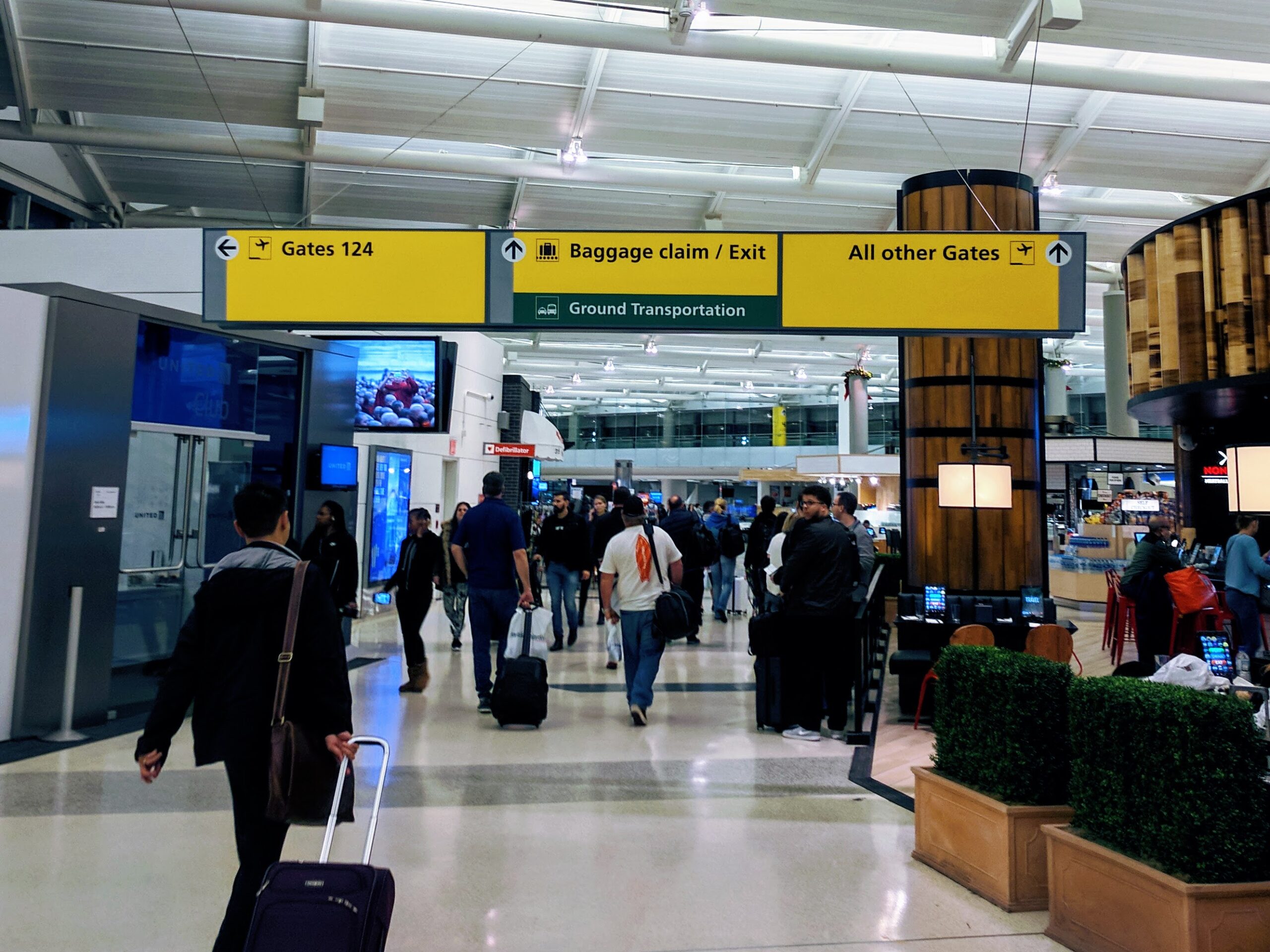
An airport restaurant result is meaningful only in relation to where the journey takes you. DFW’s official food and shopping directory organizes locations by terminal and offers a Now Open filter. The DFW directory provides those terminal-level choices. We’d use that kind of operational information before deciding that a restaurant elsewhere in the airport is a realistic meal.
At DFW, the free Skylink train connects all five terminals inside security. DFW’s Skylink FAQ describes that airside connection. This is a useful distinction from a restaurant outside security, where a meal introduces a different access problem. Even an airside connection leaves walking, waiting and eating to account for; we’d compare the complete outing rather than treat a train ride as the meal’s total detour.
A useful terminal choice may beat a more attractive airport-wide result because the latter adds a transfer or a security boundary. The question is not merely whether the airport has vegan options. It is whether a worthwhile vegan meal fits the part of the airport you can use. A restaurant’s general chain menu and the menu at its airport branch are also different pieces of information; a chain guide is a starting point for the order, while the location determines what is actually offered.
We’d spend a long connection on a better meal only when the move between terminals makes sense. With a short connection, we would favor a clear vegan meal in the reachable concourse, even if that means choosing something simpler. The airport meal is allowed to be practical. It does not need to prove that the entire terminal has become a food destination.
Find a Vegan Meal After a Late Arrival
Late dinner is where we’d be most selective about complexity. A dish needing a different sauce, a removed topping and a special preparation request may be reasonable during a leisurely restaurant visit. It is a weaker choice when the only communication is an order note and the kitchen is close to finishing service. We’d favor a plainly described vegan meal or an all-vegan restaurant over an uncertain modification chain.
Compare the dinner, not just the open restaurant
Take a hypothetical hotel arrival at 9:40 p.m. A vegan restaurant lists a 10 p.m. closing time, several mixed restaurants offer delivery, and a grocery store is open later. The vegan restaurant could be the best dinner if it can fulfill a simple order promptly. It would be a poor anchor for the evening if the plan depends on a long journey, a leisurely sit-down meal or the kitchen agreeing to keep serving.
A mixed restaurant’s vegan options may be the better choice when they include a clear main available for delivery. We would be less enthusiastic about a menu where every promising dish needs alterations the ordering system cannot express clearly. A coherent order gives the kitchen one meal to make, with fewer unresolved details between the menu and the dinner arriving at the hotel.
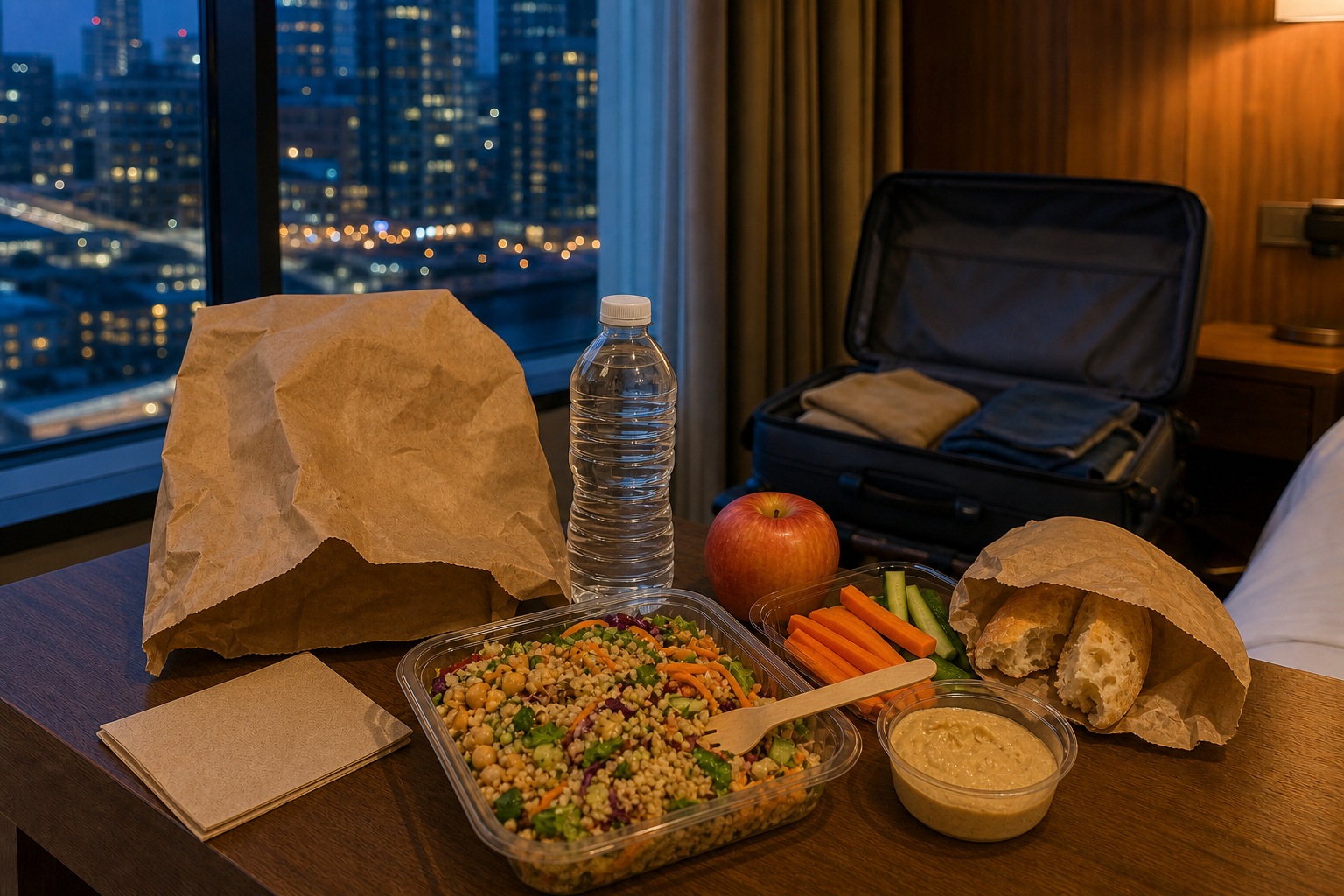
Groceries belong in the same comparison. Ready-to-eat vegan food can make a better dinner than an expensive delivery of sides, particularly if breakfast is also unresolved. We’d choose the grocery option when it provides something we’d enjoy eating now, rather than regard it only as the consolation prize after every restaurant has failed.
Room equipment and substitutions change the grocery order
A vegan meal from groceries needs to match the room. Bread, a suitable spread, vegetables and fruit offer a different kind of dinner from a chilled soup or frozen main. We would choose the latter only when the room has the equipment to make it useful. A kettle, microwave and refrigerator are not interchangeable conveniences: each supports different vegan food choices. A ready-to-eat meal may be the stronger purchase than a more ambitious dish the room cannot accommodate.
Instacart’s replacement controls are relevant here because a substitution can change the vegan basis of the order. Its current options include Best match, the default; Specific item, with up to three preferred alternatives; and Refund. A shopper may still propose a replacement after Refund, for the customer to approve or decline. Instacart’s replacement guidance explains those choices.
We’d use specific alternatives when the substitute serves the same meal. A different flavor of a product might be suitable; an item with different ingredients might not be. Where the whole dinner depends on one verified main, a refund can be better than an arbitrary replacement. The useful plan is a second meal combination, not a promise that a shopping service will infer every dietary preference from the order.
Instacart also says ingredient and dietary information can be incomplete or differ from the actual package; its vegan preference is discovery help, not a substitute for the product label. Its product-information guidance makes that limitation explicit. That matters when a substitute changes the product on which the meal depends. We’d use the app to find the grocery options, while letting the replacement’s ingredients determine whether it can stand in for the original.
Know What Still Works Without Service
Offline capability is worth comparing between vegan travel tools when it changes how you can reach dinner. A saved restaurant is useful as a reference; offline navigation is a separate feature. The right choice depends on whether the journey from the hotel is a drive, a walk or public transport.
Google Maps supports offline driving when the entire route lies within the downloaded area, but offline walking, cycling and transit directions are unavailable. Live traffic and alternative driving routes are also unavailable offline, and downloads are not offered in every country or region. Google’s offline-map guide describes those limits. We’d consider that adequate for a covered driving route, while keeping its limits in mind when comparing a rural detour or expecting a walking route after arrival.
Apple Maps on iOS 17 and later offers offline driving, walking, cycling and transit directions in supported downloaded areas, along with place details; availability varies by region. Apple describes its offline features and regional limitations. For a trip built around walking to restaurants, that is a meaningful difference from Google’s offline feature set. It is a reason to compare the supported destination and transport mode, rather than assume every downloaded map does the same job.
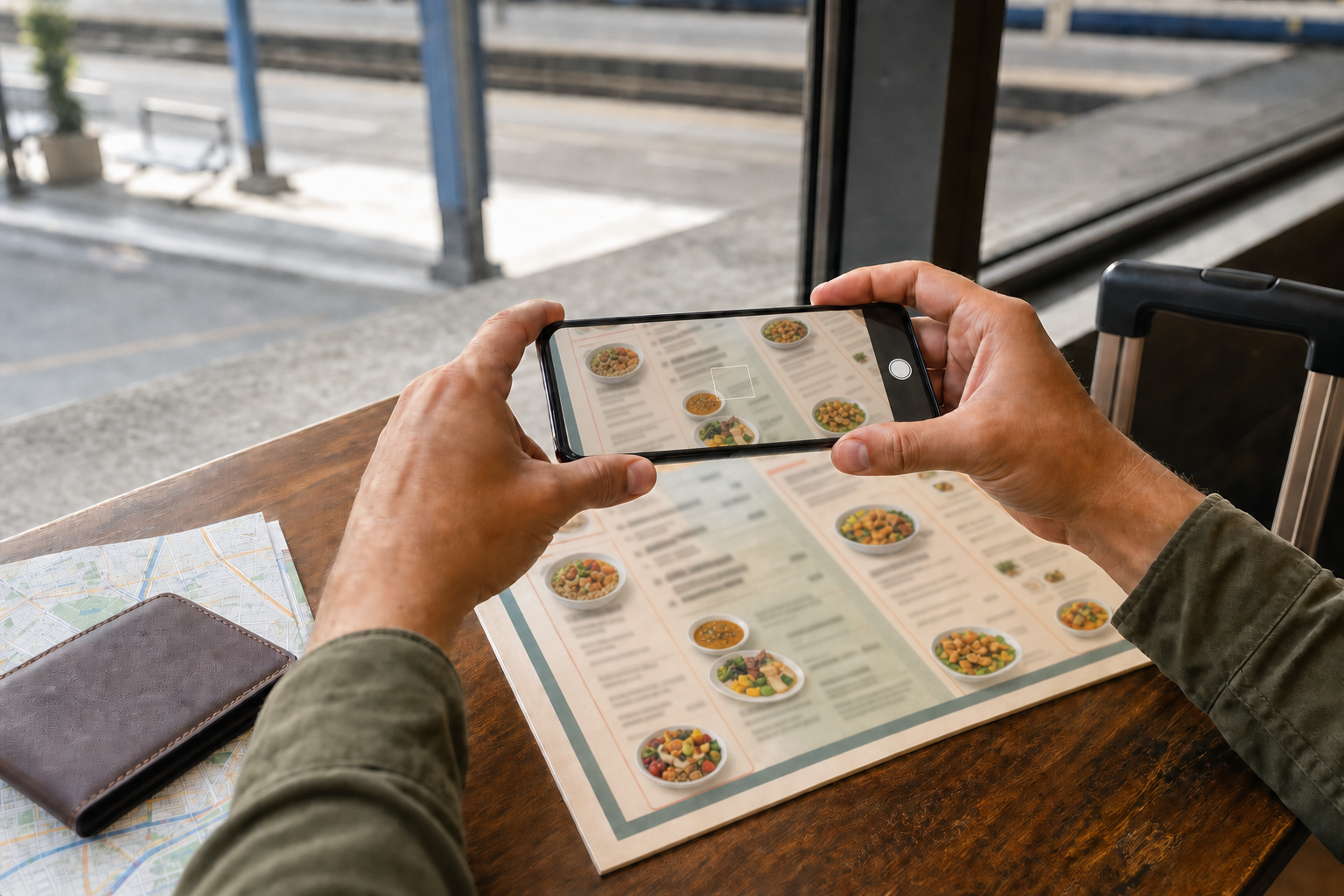
Google Translate can translate images using supported downloaded languages without a connection, but small, unclear or stylized text can reduce translation accuracy. Google’s Android image-translation guidance explains offline use and those text limitations. We would use it to understand an unfamiliar menu line or package, while treating an uncertain result as a reason to ask a focused ingredient question. The camera translating a dish name does not establish how the kitchen prepares it.
Choose a Clear Ingredient Answer and a Useful Backup Meal
Translation is most useful when the uncertainty has a shape. Tofu may be clearly named while the broth remains unexplained. A vegetable dish may look promising while its sauce is the part that needs clarification. We’d ask about the broth or sauce rather than ask someone to interpret an unfamiliar dietary label and every possible ingredient at once.
A focused question might be whether the broth contains meat or fish, whether a sauce includes dairy, or whether the bread contains honey. The point is to settle the detail that could change this order. It is not to turn a simple meal into an exhaustive kitchen interrogation. If the answer remains unclear, we’d choose a dish with a clearer preparation rather than keep translating the same ambiguous name.
The Vegan Society offers a printed Vegan Passport phrasebook, while its official travel page currently says the app is unavailable until further notice. The Vegan Society explains the phrasebook and app status. We’d consider the printed option for explaining vegan food requirements where translation is likely to be difficult. We would not make an unavailable app part of the trip’s essential tool set.

For packaged food, the guide to checking whether something is vegan explains how ingredient lists, certifications and brand information fit together. We would apply the same distinction while traveling: a discovery tool helps find possible vegan food, while the dish’s preparation or the product’s ingredients establish whether it suits you.
Make the fallback a meal you’d choose
A useful backup is not a collection of snacks chosen because they are easy to pack. It is food that can stand in for the vegan meal the journey may interrupt. We’d make that choice differently for a short flight, a full driving day and an overnight hotel arrival. The fallback needs to fit the time and place where you would actually eat it.
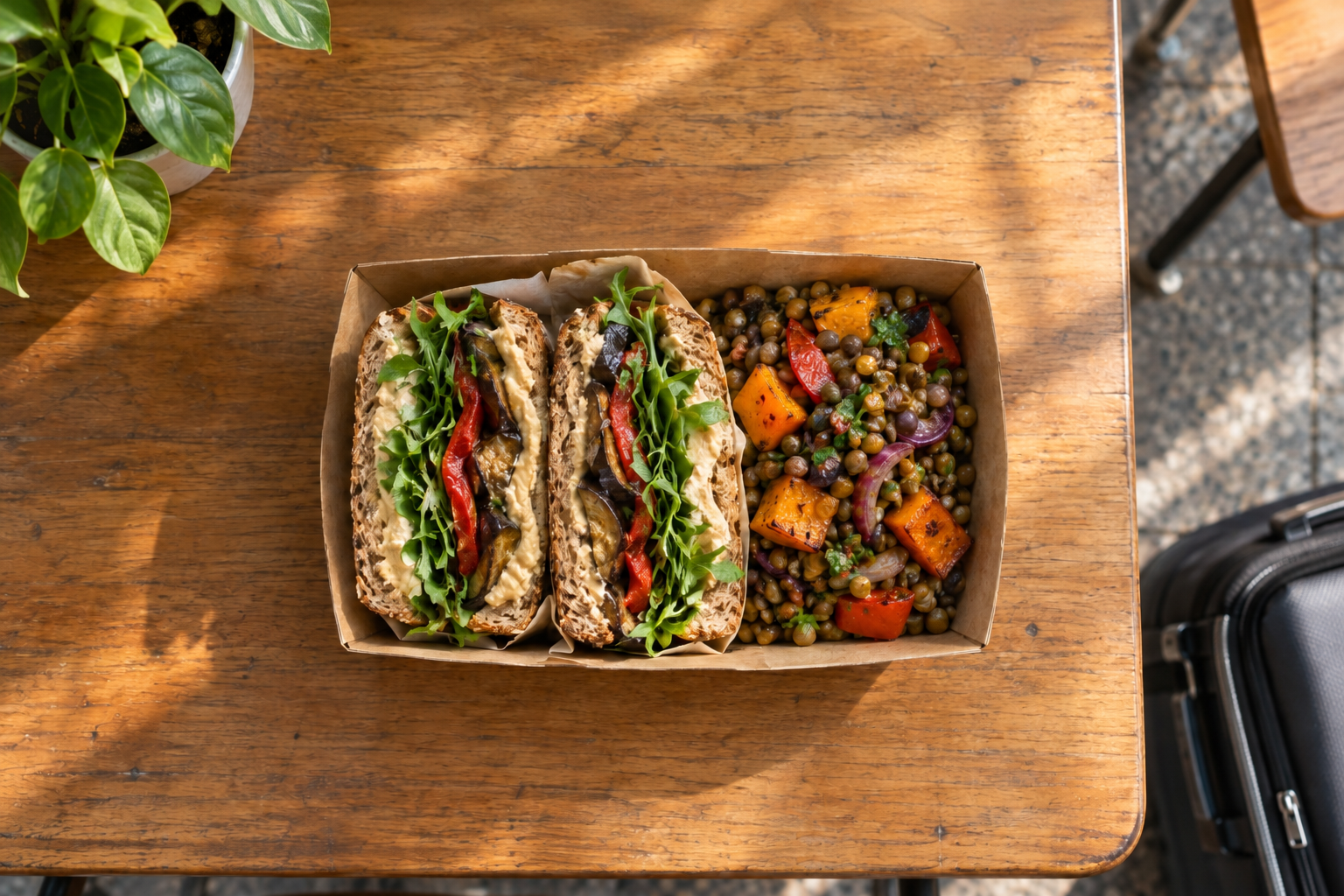
For a short journey followed by a reliable dinner, a simple sandwich or comparable portable meal may be enough. For a long vegan road trip, we’d give the main meal a proper stop and keep a smaller fallback for an unexpected delay. For a hotel arrival, a room-ready grocery combination may be more useful than carrying a food bag all day. These are choices about convenience and enjoyment, not an argument that every traveler needs the same emergency ration.
We would also avoid buying an elaborate backup that makes the rest of the trip harder. Several chilled ingredients are less useful than a simpler meal when suitable storage is uncertain. Food needing assembly, cooking or a pile of utensils belongs in a different plan from something you can eat as it is. A fallback earns its space when it makes a difficult stretch easier, not when it introduces another task.
The restaurant plan and the backup should differ in the thing that could go wrong. If both depend on the same kitchen still accepting orders, they are two menu choices rather than two ways to get dinner. If the main plan is a distant restaurant, a room-ready grocery meal offers a different option. We’d choose that kind of practical independence over another nearly identical restaurant pin.
Conclusion
Our preference is a few vegan travel tools with distinct jobs: HappyCow for a worthwhile shortlist, VeggL for a constrained order, route and airport information for access, and delivery or groceries when the evening needs a different plan. The strongest choice is the vegan meal that earns its time, works at the point of the journey where you need it and has preparation clear enough to enjoy.
A restaurant can be a reason to make a detour. It does not have to be the answer to every travel day. A good exit-side lunch, a reachable terminal meal or a deliberate hotel grocery dinner can serve the trip just as well.
FAQ
How do HappyCow and VeggL compare as vegan travel tools?
We’d choose HappyCow when comparing vegan options across restaurants and shops in an unfamiliar place. We’d choose VeggL when the available chain or venue is already known and the question is what to order there. They complement each other: restaurant discovery and a constrained menu choice are different jobs. Neither makes a meal worth a long detour just because it appears in the results.
Which app is useful for a vegan road trip?
For upcoming United States interstate exits, iExit can help compare where to stop; vegan-specific guidance then helps compare the food. HappyCow is more useful when an independent restaurant or town is worth considering as a destination. We’d judge the entire stop, including the detour and meal, rather than choose the nearest promising listing automatically.
Does requesting a vegan airline meal replace airport food planning?
We would treat it as one part of the journey. The flight has to qualify for special-meal service and the request has to meet the airline’s deadline. Food before boarding, between flights or after arrival is a separate choice. A confirmed request is useful, but it does not establish that the whole itinerary’s meals are covered.
Will offline Google Maps guide a walk to dinner?
Google Maps does not provide walking directions offline. Apple Maps offers offline walking directions in supported areas on iOS 17 and later. That difference matters for a trip where you expect to walk between the hotel and restaurants. A saved location and a downloaded map should not be confused with support for every type of route.
When are groceries better than restaurant delivery?
We’d choose groceries when they offer an appealing meal the room can accommodate, especially if breakfast is also needed. We’d choose restaurant delivery when a clear vegan order is available without complicated modifications. For grocery orders, a specific acceptable substitute or refund preference is more useful than assuming any replacement will fit the meal.