Is Honey Vegan? Why It Is Excluded and What to Use Instead
If you are asking, “Is honey vegan?”, the direct answer is no under the definition used by major vegan organizations because bees make and store it as food. The Vegan Society's definition of veganism excludes foods derived wholly or partly from animals and names honey among the foods vegans avoid.
That answer stays the same when the honey is local, raw, organic, from a backyard hive, or harvested by a careful beekeeper. Those descriptions can tell you something about distance, processing, production standards, or management. The ingredient is still made by bees.
You do not need to turn the decision into a verdict on every beekeeper or panic over a granola bar you already ate. Learn where honey appears, compare vegan honey alternatives by function, and check the next label.
Key Takeaways
- Honey is an animal-derived food, so mainstream vegan definitions and certification standards exclude it.
- Bees make and store honey as a food reserve for the colony.
- Beekeeping practices differ, but careful management does not change honey's source.
- Local, raw, and organic honey are still honey.
- Check the full ingredient list for honey and related bee products. The allergen statement is not a reliable shortcut.
- Vegan honey alternatives work best when they match the job. Agave is mild, maple syrup and date syrup add flavor, and brown rice syrup binds better.
- Buying honey and supporting native pollinators are separate decisions.
What Honey Is and Why Bees Store It
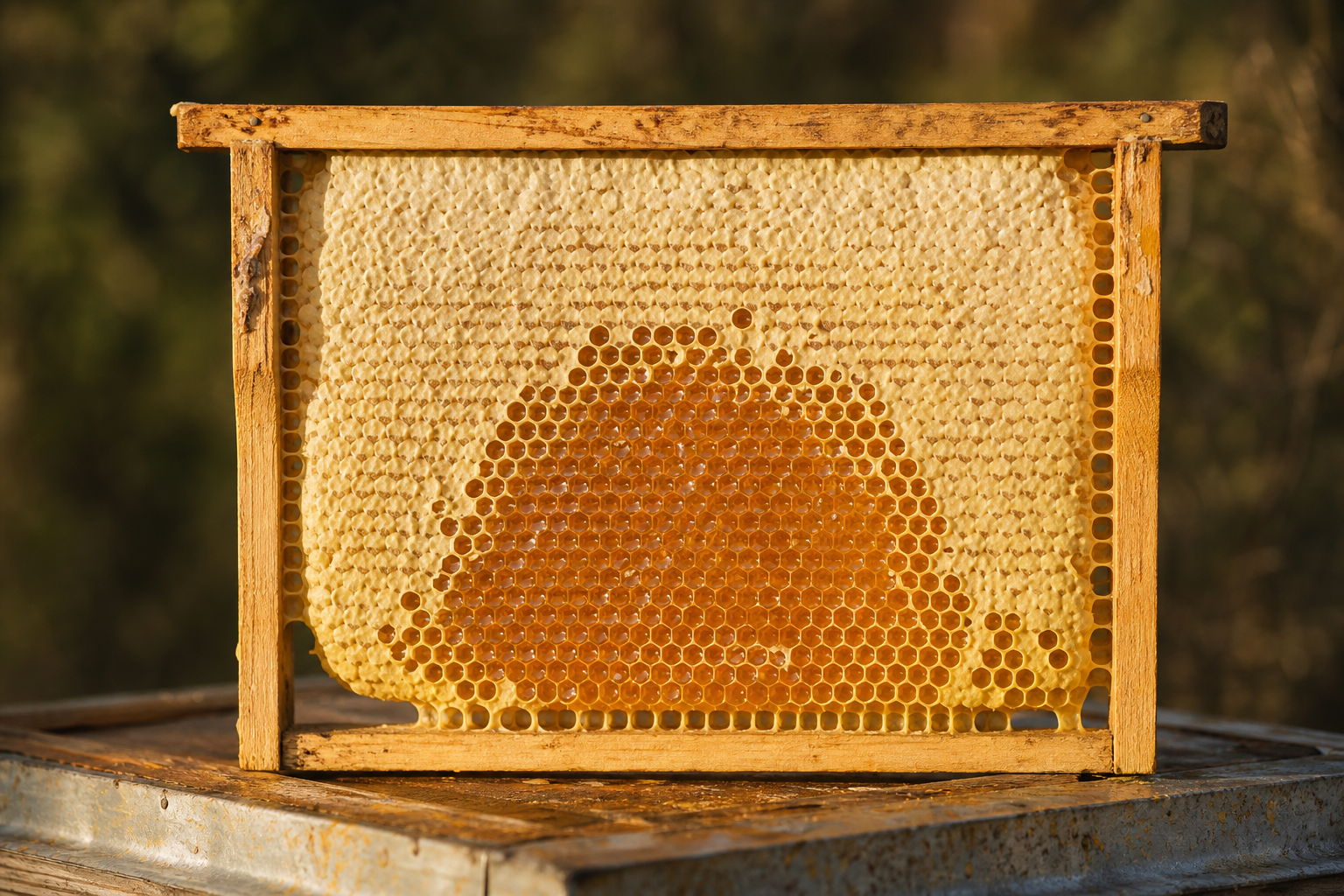
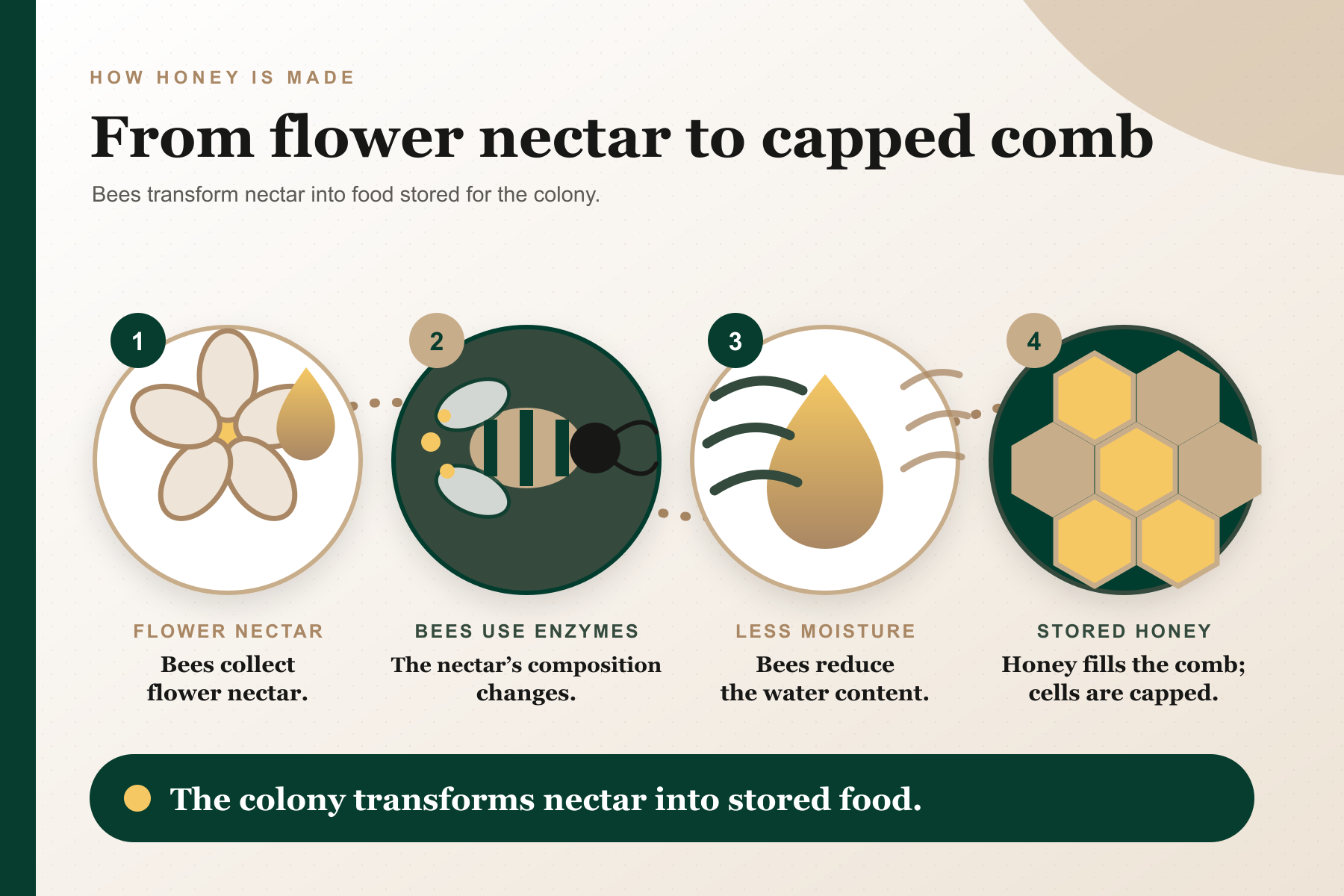
The U.S. Food and Drug Administration's honey-label guidance uses a common definition of honey: it is the substance honey bees make as food from plant nectar or plant secretions and store in honeycombs. Bees collect the liquid, process it with enzymes, reduce its water content, place it in comb cells, and cap the stored honey.
The process matters because it explains why honey is more than nectar that people happen to collect. The colony transforms and stores it. Honey provides a concentrated carbohydrate reserve when flowers are scarce and foraging is limited.
Utah State University Extension's beekeeping calendar describes honey stores as part of colony management throughout the year. Its guidance tells beekeepers to evaluate the colony's supply, harvest when stores are abundant, and avoid overharvesting before winter. That advice reflects honey's role in the hive. A colony needs adequate food reserves, and the amount available to harvest depends on forage, weather, colony health, and season.
Bees collect nectar, change its composition with enzymes, reduce its moisture, and store the finished food in comb. This process, rather than the shorthand “bee vomit,” explains how honey is produced and why it is animal-derived.
Honey also differs from pollination. A bee can pollinate a plant while collecting floral resources, but pollination is an ecological service and honey is a stored food. A person can value the role of bees in agriculture and ecosystems while deciding not to consume the food produced by a managed colony.
Why Vegans Avoid Honey
Veganism seeks to avoid animal exploitation and cruelty as far as possible and practicable. In food, that generally means leaving out meat, dairy, eggs, honey, and other ingredients derived from animals. The classification starts with the ingredient's source: bees are animals, and bees make honey for their colony.
The Vegan Society's explanation of the honey industry focuses on turning a bee-made food into a product for human use. Harvesting methods, colony treatment, and scale can affect how someone evaluates a particular apiary. The baseline vegan answer does not require evidence that every beekeeper uses the same method or causes the same degree of harm.
This distinction keeps the answer accurate. Some descriptions of honey production leap from documented industry practices to claims about every hive. Beekeeping includes commercial operations with many colonies, small local apiaries, and backyard hives. Management choices vary. Honey remains an animal-produced food across those settings.
Certification rules confirm that this is the standard food classification rather than one organization's unusual interpretation. Vegan Action's Certified Vegan standard excludes honey and other products made by honey bees. A food that intentionally contains honey would not meet that standard.
For a shopping decision, “Is honey vegan?” has a short answer: if honey appears as an ingredient, the food is not vegan. That conclusion says what the product contains. It does not tell you whether to scold someone, discard food you already bought, or investigate every practice at the supplying apiary.
“As far as possible and practicable” also has a specific role. It recognizes that people face medical, access, and other constraints. It does not make an ordinary jar of honey plant-derived. When several accessible sweeteners can perform the same everyday job, choosing one of them is a straightforward way to avoid honey.
Local, Raw, and Carefully Harvested Honey Are Still Honey
Front labels often give honey several appealing qualifiers. Each qualifier answers a narrower question than “Is honey vegan?” Read it for the information it supplies, then return to the ingredient's source.
Local identifies the source area
USDA's local and regional food guidance says there is no single agreed distance that makes a food local. In ordinary marketing, local honey signals a geographic connection between production and sale, but the boundary varies. If the claim matters to you, ask where the hives are located and where the honey was processed or packed.
None of those facts changes who made the honey. Bees gathered, processed, and stored it. Local describes geography and commercial connection. Vegan status concerns whether the food is derived from animals.
Buying from a named nearby producer may make it easier to ask how the hives are managed. That conversation can clarify sourcing. It cannot change honey into a plant product.
Raw identifies processing
USDA's commercial specification for honey defines raw honey as honey in the hive or honey obtained by extraction without filtration. The same specification distinguishes raw, unfiltered, filtered, and strained honey, so read raw as information about handling after the hive.
Processing happens after bees produce the honey. Less processing does not alter its animal origin. The same reasoning applies to unfiltered, small-batch, or single-origin honey. Those terms may help a customer compare honey products, but none makes one suitable for a vegan ingredient list.
Organic identifies a production standard
USDA's organic-labeling guidance treats organic as a production, handling, certification, and labeling standard. It specifically says honey may be certified under the current production and handling standards. Organic does not mean “free of animal-derived ingredients.” Organic meat, dairy, and eggs remain animal products, and organic honey remains honey.
This is why a single front-label word should not carry the full decision. “Organic,” “natural,” and “plant-based” can each communicate something narrower than a verified vegan standard. The ingredient statement and a credible certification give you better evidence for the food question you are asking.
Beekeeping practices vary
Penn State Extension's seasonal honey-bee management guidance covers decisions such as swarm control, queen management, mite treatment, feeding, and preparing colonies for seasonal changes. Utah State's guidance also directs beekeepers to monitor food stores and avoid taking too much honey. These sources show why sweeping claims about all apiaries are unreliable.
A careful beekeeper may leave generous winter stores, monitor colony health, and harvest only a surplus. Another operation may make different choices. Those differences can matter if you are evaluating animal treatment, environmental effects, or which local business to support. They do not change the basic ingredient classification.
You can hold both points at once: practices differ, and honey is still animal-derived. That avoids caricaturing every beekeeper while giving a clear answer to a reader who wants to choose vegan food.
If this kind of edge case keeps turning into a broader debate, The Gray Areas shows how to separate the fact you can establish, the value you are applying, and the choice available to you.
How to Find Honey on a Food Label
Start with the ingredient statement and scan for the word honey. In a properly labeled multi-ingredient food in the United States, ingredients are listed by their common or usual names in descending order by weight, according to FDA's Types of Food Ingredients page. When honey is added to granola, bread, dressing, cereal, or another packaged food, it should appear in that list.
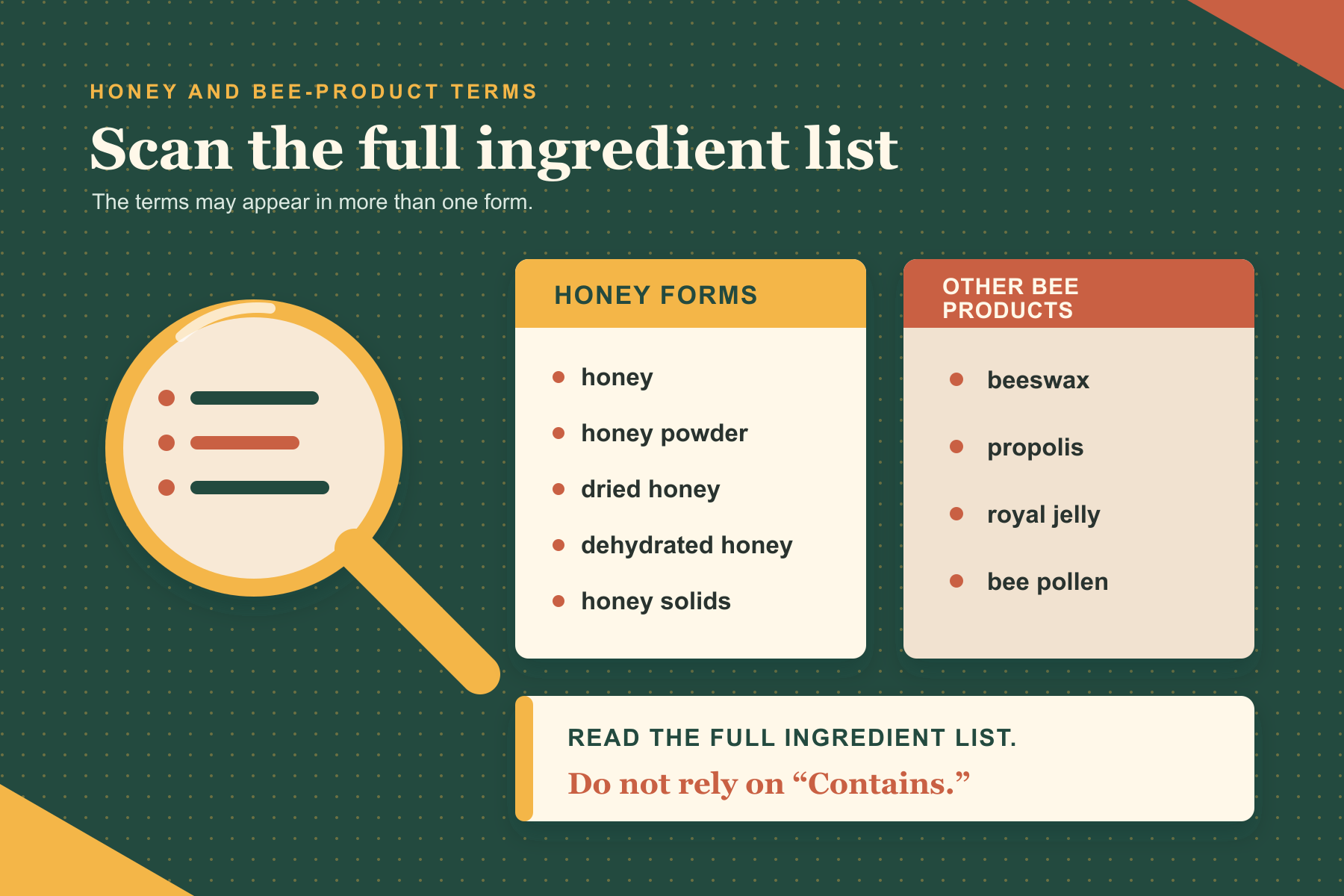
Honey may also appear in a processed form. Check for:
- honey powder
- dried honey
- dehydrated honey
- honey solids
Other bee products are separate ingredients but also fall outside common vegan standards:
- beeswax
- propolis
- royal jelly
- bee pollen
These ingredients show up in more places than the sweetener aisle. Check granola, snack bars, breakfast cereal, breads, crackers, roasted nuts, sauces, dressings, glazes, candy, flavored tea, supplements, lozenges, and cough products. You do not need to assume every item in those categories contains honey. They are simply sensible places to read the label.
A pure jar of honey may have no separate ingredient list. FDA guidance allows a single-ingredient product to be identified by the common name “honey” on the front of the package. In that case, the product name already tells you what it contains.
Honey is not one of the nine major food allergens covered by U.S. labeling law, so a package can contain honey without naming it in a “Contains” statement. Read the full ingredient list.
Product names can also create false alarms. Honeycrisp apples, honeydew melon, and honeybush tea do not contain honey merely because their names begin with “honey.” A “honey-flavored” product could use honey, another flavor source, or a mixture. Read the ingredients. If the source remains unclear, ask the manufacturer about the exact product and formula.
Restaurant menus require the same specific approach. A dish name or short description may omit a sweetener used in a sauce, glaze, bread, or dressing. Ask whether the item contains honey and, when needed, whether a sauce can be left off. The question is easy for staff to answer when you name the ingredient instead of asking them to interpret every edge of veganism.
For a broader label routine, use our guide to checking whether something is vegan. The hidden animal ingredients guide covers other names that deserve a closer look after you have checked for honey.
Vegan Honey Alternatives by Use
The best vegan honey alternatives solve the job honey performs. Sweetness is only one part of the decision. Flavor, thickness, moisture, browning, and binding can change the result.
| Use | First choice | Decision note |
|---|---|---|
| Tea and cold drinks | Agave or simple syrup | Both mix easily and have a milder flavor than dark maple or date syrup. |
| Pancakes, oatmeal, toast, and yogurt | Maple syrup or date syrup | Maple tastes cleaner and woodier; date syrup brings a darker fruit note. |
| Dressings, marinades, and glazes | Maple syrup or agave | Add it gradually, then adjust salt and acid. |
| Granola and snack bars | Brown rice syrup or thick date syrup | Their thicker texture usually binds better than a thin syrup. |
| Cakes, cookies, and quick breads | A tested recipe written for agave, maple, or another liquid sweetener | Liquid sweeteners affect moisture, browning, texture, and structure. |
| A honey-like flavor | A verified bee-free honey alternative | Read the full ingredients and look for a credible vegan certification. |
Tea and cold drinks
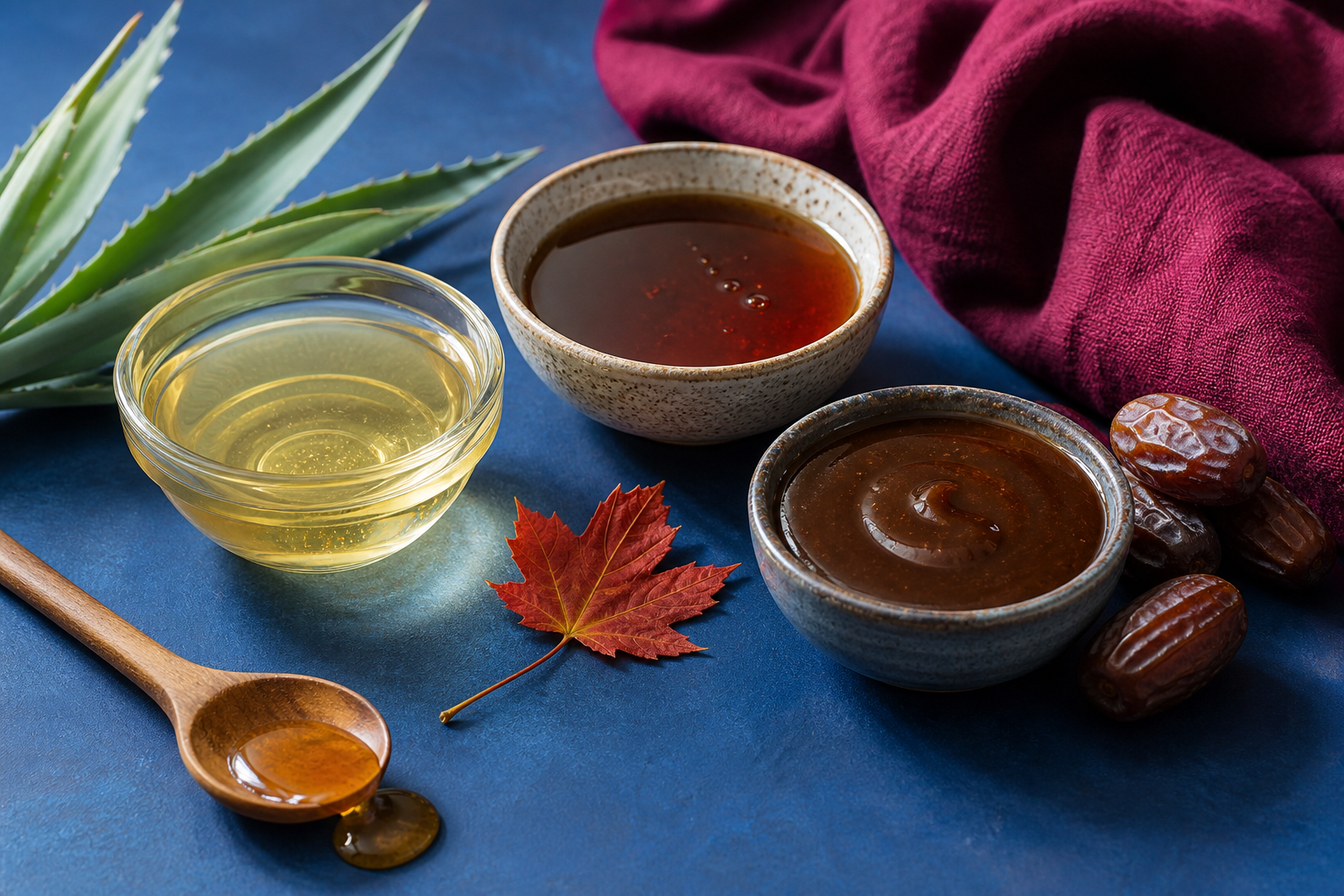
Agave is a dependable first choice when you want sweetness without a strong flavor. Its liquid texture makes it easy to stir into hot tea, iced tea, lemonade, and other cold drinks. Simple syrup also dissolves readily because the granulated sugar is already dissolved in water.
Maple syrup works when its flavor suits the drink. A dark maple syrup can be pleasant with coffee, warming spices, or black tea, but it may dominate a delicate herbal tea. Date syrup is usually stronger and may leave more flavor or body. Choose it because you want that result, not because every liquid sweetener is interchangeable.
Pancakes, oatmeal, toast, and yogurt
Maple syrup is the closest easy replacement for pouring over breakfast foods. Its texture is thinner than many honeys, but that rarely creates a problem on pancakes, waffles, oatmeal, toast, or vegan yogurt.
Date syrup gives those foods a deeper, fruitier sweetness. It pairs well with oats, nuts, cinnamon, and tahini. Agave is milder and works when the other flavors should lead.
For a thick spread, a liquid syrup may make toast soggy or slide off fruit. Combine the sweetener with nut or seed butter, or choose a thicker bee-free product whose ingredients fit the dish.
Dressings, marinades, and glazes
Honey often balances acid, salt, bitterness, or heat in a dressing or sauce. Maple syrup and agave can do the same job. Add a little, taste, and adjust the other ingredients. A sweeter sauce may need more vinegar or citrus; an acidic dressing may need another small addition of sweetener.
Thickness matters in a glaze. Maple and agave are often thinner than honey, so a recipe may coat differently. Reduction can thicken some cooked sauces, but follow the recipe's food-safety and cooking instructions. For an uncooked dressing, mustard, tahini, or another emulsifying ingredient may provide body when it already belongs in the formula.
Do not judge the result by sweetness alone. A maple-based mustard dressing will taste like maple. That may be welcome. If you want a more neutral result, agave is usually the easier starting point.
Granola and snack bars
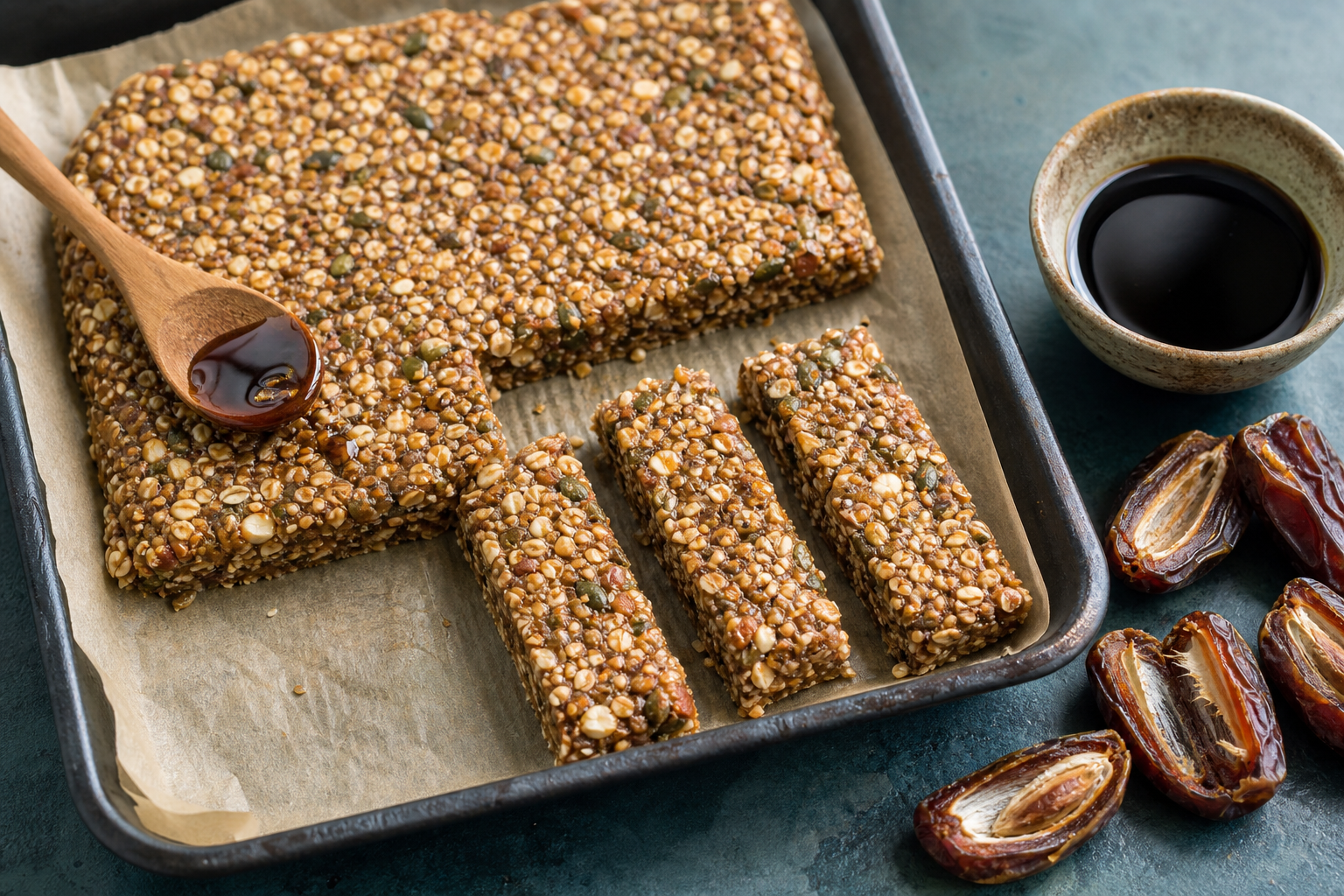
Honey can sweeten and bind at the same time. Brown rice syrup is thick and sticky, which makes it a strong candidate for granola clusters and snack bars. Thick date syrup can also help ingredients cling together while adding a darker flavor. Start with brown rice syrup when firm binding matters more than a maple flavor.
Maple syrup may make excellent granola, especially in a recipe designed around it. It is less dependable as the only binder in an unbaked bar because a thinner syrup may not hold nuts, oats, and seeds together. Use a tested formula when the bar needs to survive packing, cutting, and carrying.
The rest of the recipe matters too. Nut or seed butter, finely ground ingredients, baking time, cooling time, and the ratio of dry ingredients all affect whether a bar holds. Swapping one syrup without considering those parts can produce crumbs even when the sweetness tastes right.
Cakes, cookies, and quick breads
Liquid sweeteners change a baked recipe in several ways. The University of Maine Cooperative Extension's baking guidance notes that sugar affects browning, tenderness, texture, and structure. Replacing honey with another syrup can also change moisture and flavor.
Use a recipe already written or tested for maple syrup, agave, brown rice syrup, or the liquid sweetener you have. This is especially helpful for cakes and cookies, where the balance between liquid, fat, flour, and leavening determines the texture.
A direct spoon-for-spoon change may work in a forgiving sauce and fail in a cookie. Without a tested substitution, expect to adjust more than sweetness. The amount of other liquid, the baking temperature, and the dry ingredients may all need attention. A tested vegan recipe saves that guesswork.
Bee-free honey alternatives
Some products are designed to resemble honey's color, flavor, or texture without bee ingredients. The exact base varies, so read the ingredient list. Look for a credible vegan certification when available, and make sure the formula does not include honey, beeswax, propolis, or another bee product.
The words “bee-free,” “plant-based,” or a honey-style package can guide you toward a candidate. They are not a substitute for checking the specific jar. Products and formulas can change, and two similar-looking alternatives may use different ingredients.
Nutrition is a separate question
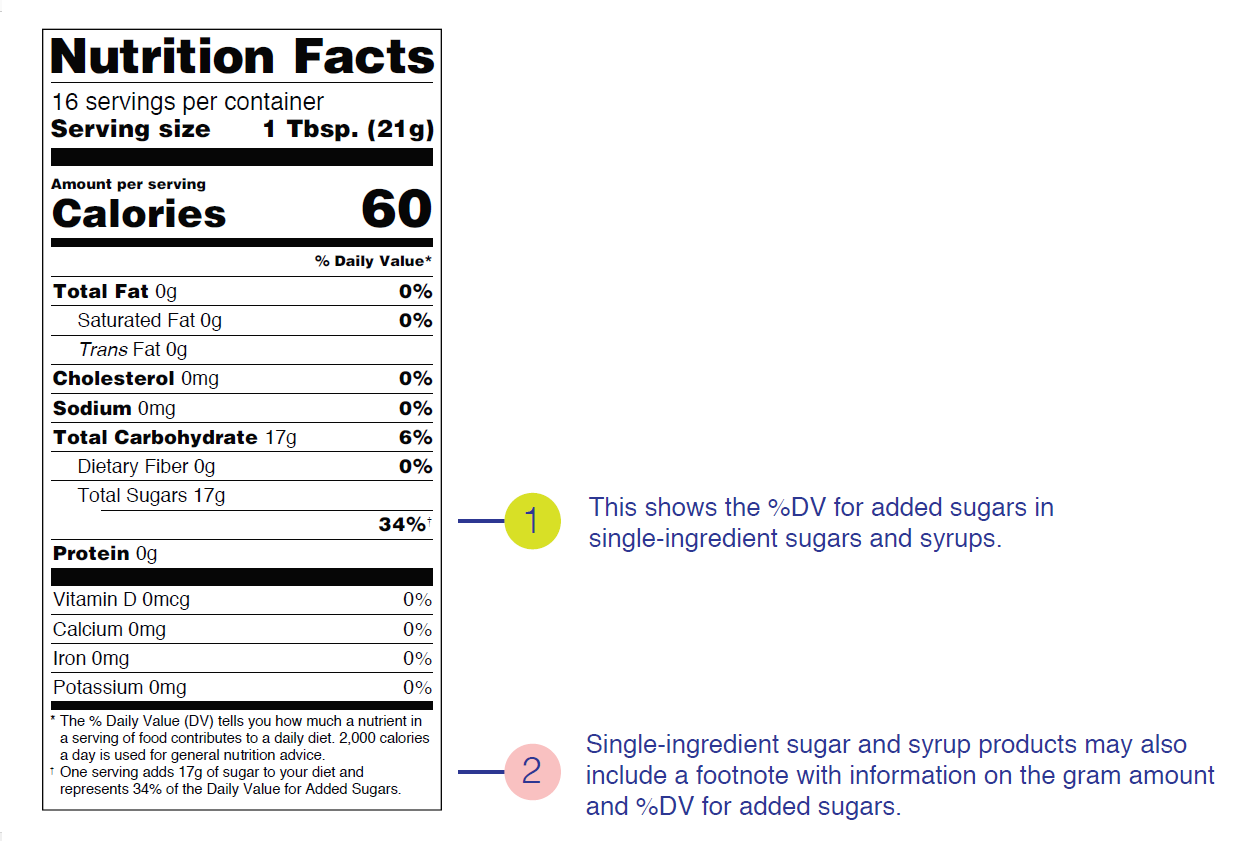
The FDA's added-sugars guidance counts honey, maple syrup, agave, and other syrups as added sugars when they are added to foods. Replacing honey with a plant-derived syrup answers the vegan ingredient question. It does not automatically turn a dessert, drink, or breakfast into a lower-sugar choice.
Compare taste, function, serving amount, and the Nutrition Facts label when nutrition affects your decision. Choose a syrup for taste and function rather than assuming a plant-derived sweetener is healthier.
Do not give honey to a baby under 12 months
The Centers for Disease Control and Prevention's infant-feeding guidance says children younger than 12 months should not be given honey because it can cause infant botulism. This applies whether the honey is raw or pasteurized and whether the household is vegan.
Use age-appropriate feeding guidance from the child's clinician for other sweeteners and foods. Keep that safety rule separate from nutrition comparisons among syrups.
Honey Bees and Native Bees Need Different Help
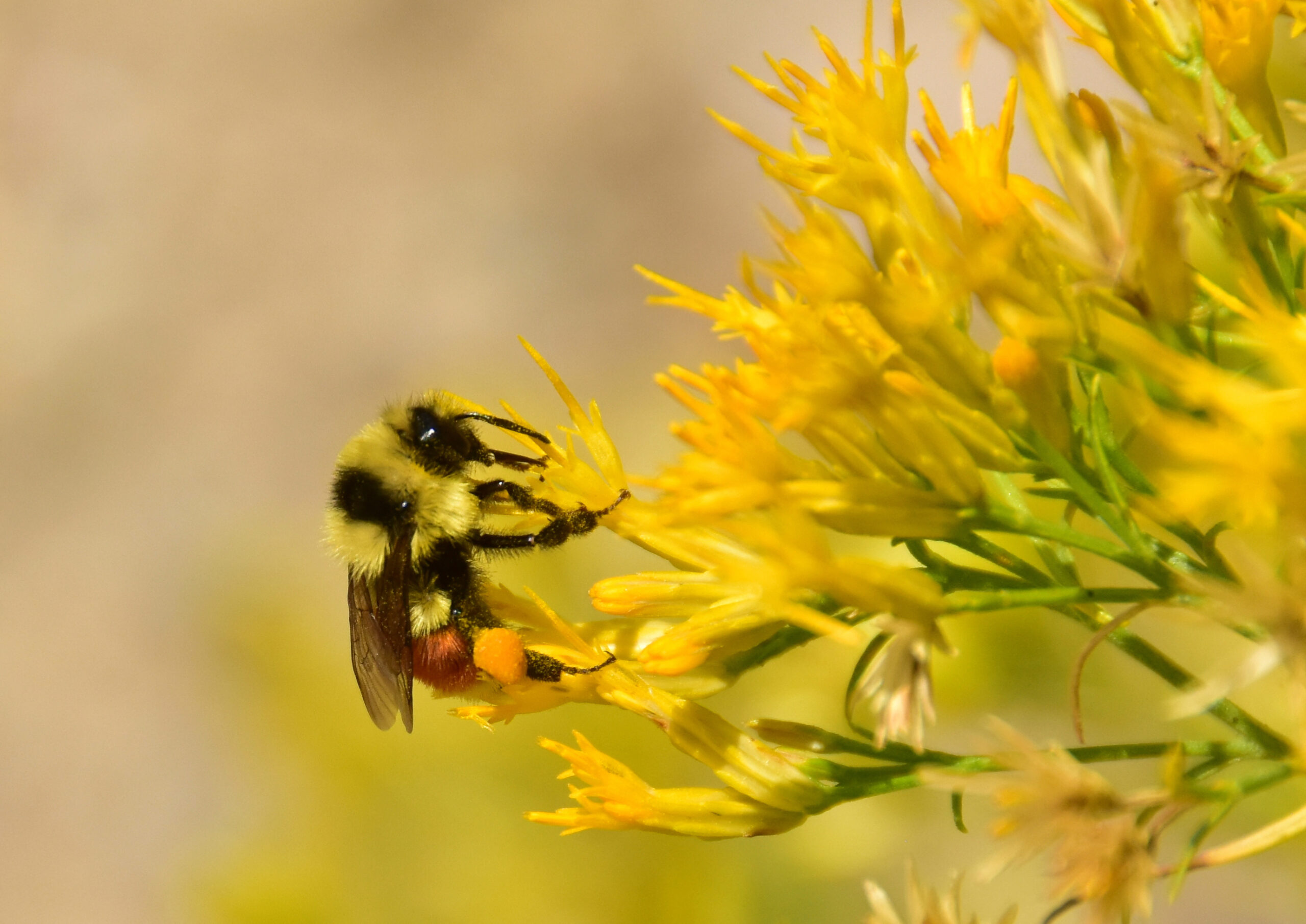
Honey bees are managed agricultural animals in the United States. They pollinate crops and produce honey under human management. Native bees include many species with different nesting habits, diets, ranges, and relationships to local plants.
The USDA National Agricultural Library's beekeeping overview notes that honey bees are not native to the United States and that North America has more than 4,000 native bee species. “The bees” is therefore too broad when you are deciding what kind of conservation action to take.
Managed honey bees and wild bees can visit the same flowers. A 2026 systematic review of managed honey bees and wild bees found extensive overlap in floral resources across the research it examined. Direct effects on wild-bee survival, reproduction, and population outcomes were measured less often, and results were not uniform across studies.
Location, flower abundance, season, hive density, and the wild-bee species being studied can all affect the relationship. That evidence supports careful local decisions. It does not support a promise that buying honey will conserve native bees, and it does not establish that every managed hive damages the surrounding wild-bee population.
If your goal is to help wild pollinators, take actions that create or protect what they use. The University of Minnesota Extension's Habitat for pollinators on fruit and vegetable farms recommends flowering plants across the growing season, nesting habitat such as bare ground and hollow stems, and protection from pesticide drift.
Even a small yard, patio, or balcony can support pollinators with early-, mid-, and late-season flowers. Leave appropriate stems, bare ground, leaf litter, or other nesting features where local guidance recommends them. Avoid pesticide use when you can, follow labels when treatment is necessary, and prevent chemicals from reaching open flowers.
These actions address habitat and pesticide exposure directly. If your goal is to help native bees, plant for several flowering periods, protect nesting habitat, and reduce pesticide exposure.
What to Do If You Already Ate Honey
If you discover honey after eating the food, check the label or restaurant information and identify where it appeared. Save the product name if you are likely to buy it again. Then choose an alternative next time.
You do not need to throw away the rest automatically. If keeping it is uncomfortable, you can offer an unopened or safely shareable item to someone who will use it. If the food is already prepared, decide what prevents waste and fits your circumstances. One missed ingredient does not erase the choices you make before or after it.
For restaurant food, note the sauce, dressing, bread, or glaze that contained honey and ask a more specific question on the next visit. For packaged food, compare nearby options or contact the manufacturer if the label is unclear. This turns the mistake into a repeatable check.
Medicine deserves separate care. The Vegan Society advises people not to stop prescribed medicine because it contains an animal-derived ingredient. Ask a clinician or pharmacist whether a suitable alternative exists, and continue prescribed treatment unless the professional responsible for your care changes it. A culinary syrup is not a substitute for a medicine that contains honey.
How We Think About This explains the site's broader approach to choices shaped by evidence, access, and consequences.
Is Honey Vegan? No, and Replacing It Is Usually Simple
Honey is animal-derived because bees make and store it as food, so mainstream vegan definitions exclude it. Local sourcing, raw processing, organic certification, and careful beekeeping can inform other decisions. They do not change the ingredient's origin.
At the store, scan the full ingredient list for honey and related bee products. The most useful vegan honey alternatives are matched to the task: agave for mild sweetness, maple syrup or date syrup when you want their flavor, and brown rice syrup when binding matters. Choose a tested recipe when a liquid sweetener affects the structure of a cake, cookie, quick bread, or snack bar.
If you miss honey in a product, note it and adjust the next purchase. If your goal is to help native bees, focus on flowers across the growing season, nesting habitat, lower pesticide exposure, and local habitat protection.
Want fewer label surprises? Subscribe for The Things Nobody Tells You and get new guides and smart finds.
Frequently Asked Questions
Is local honey vegan?
No. The answer to “Is honey vegan?” does not change with a local claim. Local describes where the honey was produced or sold. Bees still made and stored it, so it remains an animal-derived food.
A local source may make it easier to learn about hive management, harvesting, and the business you are supporting. Those facts can matter to your broader evaluation. They do not change the vegan classification.
Is raw or organic honey vegan?
No. Raw describes processing, while organic refers to a production standard. Neither term changes honey's animal origin.
The same answer applies to unfiltered, single-origin, small-batch, backyard, and carefully harvested honey. Each label may provide information about the product or producer, but the product is still made by bees.
Is bee-free honey vegan?
It can be. Check the exact ingredient list and look for a credible vegan certification. A bee-free product should not contain honey, beeswax, propolis, royal jelly, bee pollen, or another bee-derived ingredient.
Do not rely only on the front label, jar shape, color, or the word “plant-based.” Verify the formula you are buying because products with similar marketing can use different ingredients.
What should I use instead of honey in baking?
For vegan honey alternatives in baking, start with a recipe tested for agave, maple syrup, brown rice syrup, date syrup, or another liquid sweetener. Honey contributes liquid, sweetness, browning, and texture, so a direct swap can change the finished bake.
For granola or snack bars, a thick syrup such as brown rice syrup may bind better than maple. For cakes, cookies, and quick breads, follow a recipe designed around the replacement whenever structure matters.
What if a prescribed medicine contains honey?
Do not stop prescribed treatment on your own. Ask a clinician or pharmacist whether an appropriate alternative is available. The “possible and practicable” part of the vegan definition recognizes that medical choices can involve constraints that do not apply to an ordinary sweetener purchase.
Do not replace a medicine with agave, maple syrup, or another kitchen ingredient. A similar taste or texture does not establish the same medical effect.
Can a baby under 12 months have honey?
No. CDC guidance says not to give honey to a child younger than 12 months because of the risk of infant botulism. Raw, pasteurized, local, and commercially packaged honey all fall under that warning.
Ask the child's clinician for advice about age-appropriate foods and sweeteners. The infant safety rule is independent of whether the household follows a vegan diet.